

News and Views
Why Do Custom Challenge Coins Cost So Much More When You Only Order a Few?


The surprising truth about pricing, setup costs, and why buying more almost always saves you money.
If you’ve ever shopped around for custom challenge coins in Australia, you’ve probably noticed something that feels a little backwards: the price per coin drops dramatically the more you order. A run of 30 coins might set you back $25–$35 per coin, while an order of 300 of the same coin comes in at $8–$12 each. Order 500 or more, and you might get them under $7 a piece.
So what’s going on? Are manufacturers punishing small orders? Is it some kind of bulk-buyer’s club you weren’t told about?
Not exactly. The answer comes down to a concept called economies of scale — and once you understand it, the pricing makes complete sense.
The Hidden Cost You’re Actually Paying For
When you order a custom challenge coin, you’re not just paying for the metal, the enamel, and the labour to assemble it. You’re paying for all the work that has to happen before a single coin rolls off the production line.
This includes:
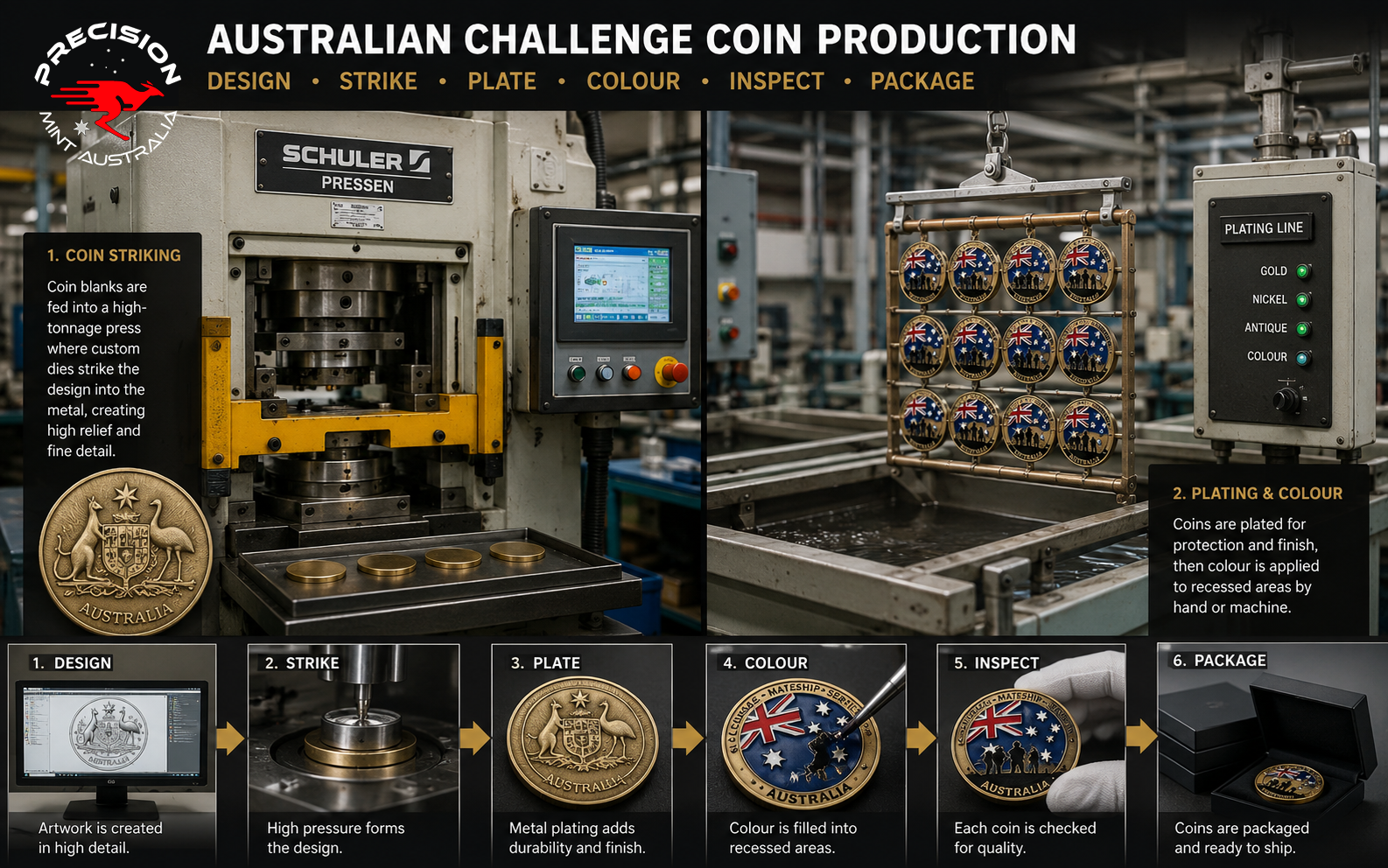
Die creation. Every custom coin design requires a custom die — essentially a precision-cut metal mould that stamps your design into each coin blank. Designing and cutting that die is skilled, time-consuming work. In Australia, die setup fees typically run anywhere from $100 to $300 or more per design, depending on complexity.
Artwork and proof approval. Someone has to take your design concept, translate it into a production-ready file, and send you a proof for approval. That’s real labour time, regardless of how many coins you’re ordering.
Machine setup. The stamping machinery needs to be calibrated, loaded, and tested for your specific coin spec — diameter, thickness, edge style, plating type. This takes time every single run, whether you’re making 30 coins or 3,000.
Colour mixing and enamel prep. If your coin includes coloured enamel fill (and most custom coins do), each colour needs to be mixed and prepared. That preparation cost exists for every colour in your design, on every order.
All up, you might be looking at $200–$500 in fixed setup costs before the first coin is even made.
The Maths That Explains Everything
Here’s where it clicks. Those setup costs don’t change based on how many coins you order. They’re fixed. So the question becomes: how many coins are you spreading them across?
Let’s say your setup costs come to $300.
| Order Quantity | Setup Cost Per Coin | Production Cost Per Coin | Approx. Total Per Coin |
|---|---|---|---|
| 30 coins | $10.00 | $5.00–$8.00 | $15–$18+ |
| 100 coins | $3.00 | $4.00–$6.00 | $7–$9 |
| 300 coins | $1.00 | $3.50–$5.00 | $4.50–$6 |
| 500 coins | $0.60 | $3.00–$4.50 | $3.60–$5.10 |
(These are illustrative figures for the Australian market. Actual quotes will vary by supplier, coin size, plating, and design complexity.)
The coins themselves aren’t dramatically cheaper to produce in larger runs — the stamping machine doesn’t care whether it’s punching out coin number 30 or coin number 300. What changes is how much of that fixed setup cost each coin has to “carry.”
Ordering 30 coins and expecting a price similar to 300 coins is a bit like hiring a chef to cook a single serve of a complicated dish — you’re still paying for all the prep, the mise en place, and the cleaning up.
There’s More to It Than Just Setup Costs
Setup costs are the biggest factor, but they’re not the only one working against small orders.
Raw materials are cheaper in bulk. Suppliers don’t charge the same per-unit price for 1kg of brass blanks as they do for 50kg. Manufacturers buying materials for a 300-coin run get better rates than those buying for 30, and some of that saving flows through to you.
Labour efficiency improves with volume. Once the machine is running and calibrated, each additional coin costs relatively little extra labour. The expensive part is getting started. A production worker running 300 coins through a polishing and plating process is more efficient per coin than doing the same for 30.
Shipping and handling is proportional to the order, not the work. Packing, quality-checking, and dispatching 30 coins takes almost as much effort as 300.
What This Means If You’re Planning a Custom Coin Order
Don’t order the bare minimum if you think you’ll need more later. If you order 30 coins today and come back in six months for another 30, you’ll pay the setup fee twice. Ordering 60 upfront will almost certainly be cheaper overall — and you’ll have spares on hand.
Think about the total cost, not just the unit price. A quote of $18 per coin for 30 units might look alarming next to $7 per coin for 300 — but if you genuinely only need 30, the maths still works out. You’re paying $540 versus $2,100. Just make sure you’re comparing the right numbers.
Ask about die ownership. Some Australian suppliers will let you “own” the die once it’s paid for, meaning future reorders carry lower setup fees. Others recondition or remake the die each time. This matters a lot if you’re planning repeat orders — for example, an annual run for a sporting club, a corporate awards program, or a military unit.
Order sizes around price break points. Most suppliers structure their pricing around specific quantity tiers — often 50, 100, 150, 250, 300, 500. If you need 80 coins, it’s worth getting a quote for 100. The price difference per coin often more than offsets the cost of the extra 20.
So, Is It Worth Ordering More Than You Need?
Sometimes, yes — genuinely.
If you’re running a footy club and commissioning coins for a premiership season, ordering 250 instead of 150 “just in case” might cost you an extra $400–$600 total but drop your per-unit price enough that you’re essentially getting 100 coins for next to nothing. Those extras become raffle prizes, coach gifts, or stock for next year.
If you’re a business commissioning coins for a corporate milestone, ordering conservatively and then reordering is almost always more expensive than getting the quantity right the first time.
That said, don’t over-order just to chase a low unit price. Coins you don’t use are coins you paid for. Run the actual numbers for your situation.
Disclaimer: These pricing examples are for illustration only. Ask for a free quote to confirm yours.