

News and Views
The Coin That Wasn’t What It Seemed


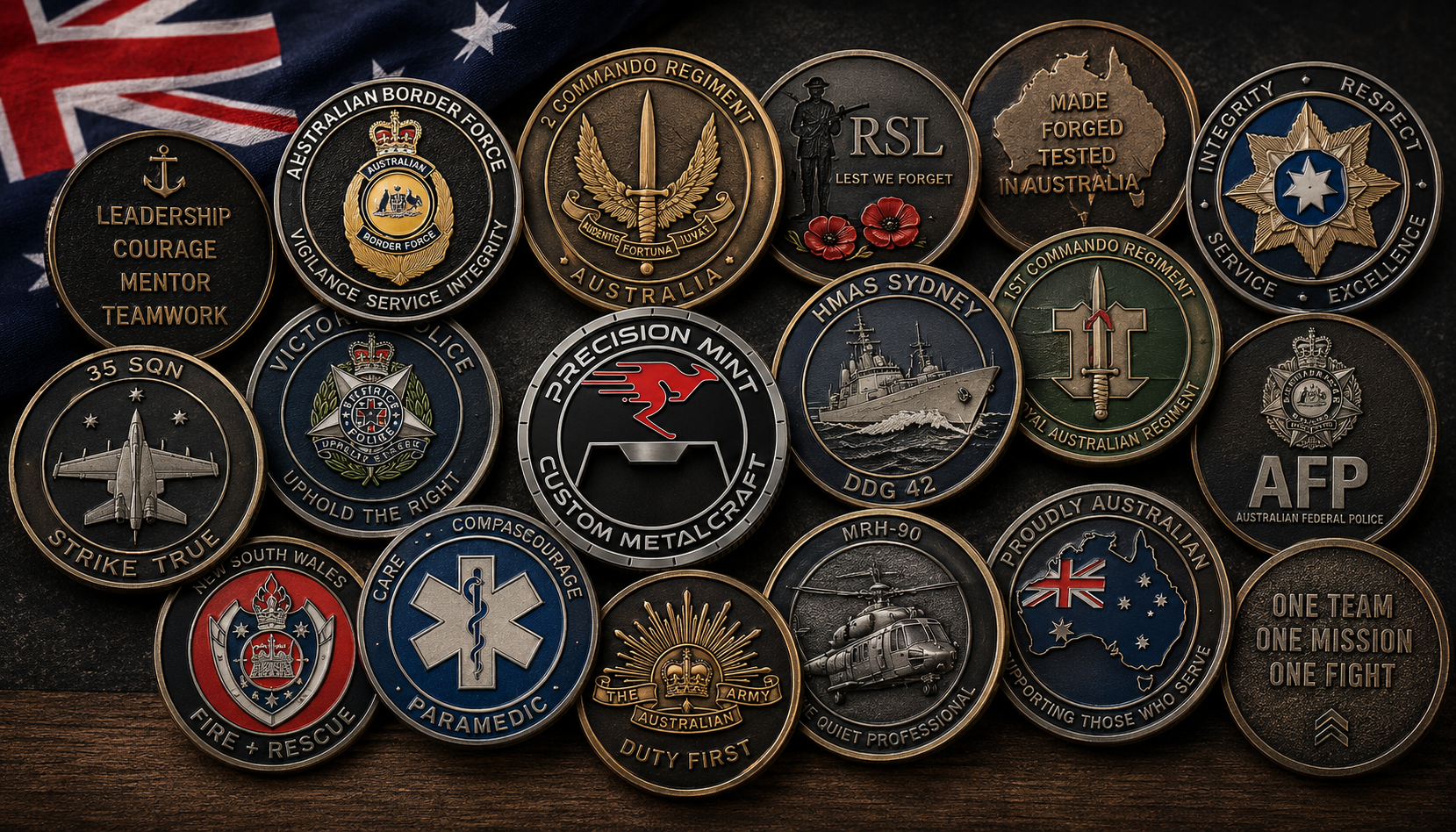
You clicked “accept quote” on something that glowed like a relic from a Hollywood prop room. Sadly though, what arrived was a different story entirely — and you’re not alone.
The satchel arrives. You tear it open with the enthusiasm of someone who has been refreshing the tracking page for a week. You spent good money — maybe serious money — on what our competitor’s website showed as a glittering, mirror-finished medallion with razor-sharp relief detail, colours so saturated they practically vibrated off the screen, and edge lettering so crisp it looked laser-engraved by the hands of angels.
Then you hold the actual coin under your flouro light, and something quietly deflates inside you.
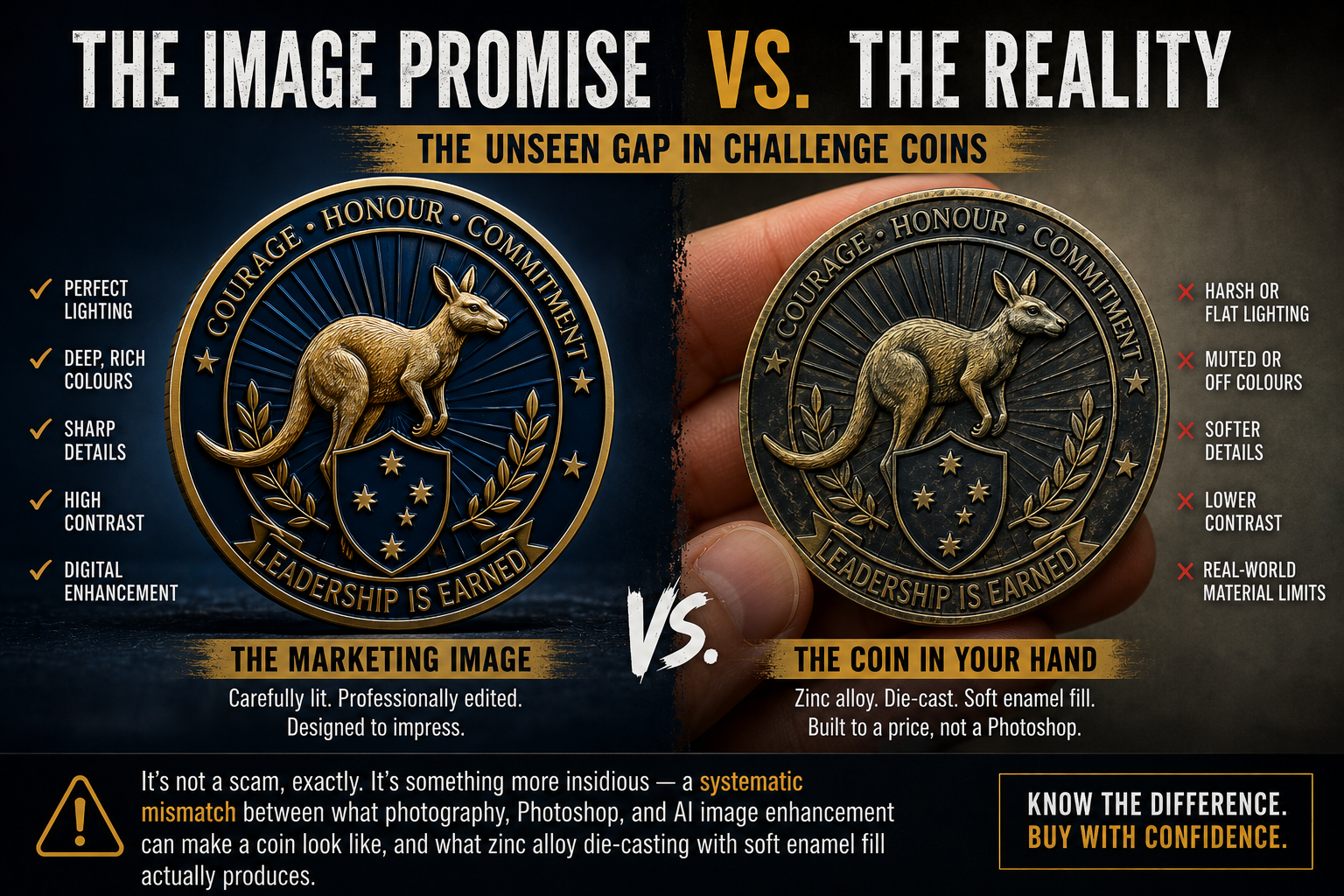
Welcome to one of the most common and least-talked-about disappointments in the challenge coin world: the gap between the marketing image and the metal in your hand. It’s not a scam, exactly. It’s something more insidious — a systematic mismatch between what photography, Photoshop, and AI image enhancement can make a coin look like, and what zinc alloy die-casting with soft enamel fill actually produces.
The Photography Problem
Let’s start with the honest culprit: professional product photography. Coin vendors invest heavily in making their sample coins look extraordinary under controlled conditions. Macro lenses. Ring lights angled to make every ridge cast a dramatic shadow. Polarising filters that kill glare and make enamel look like stained glass. A single product photo session might involve hours of setup for five usable images. The result is an artefact of photography, not an accurate portrait of the object.
The coin you receive was photographed under conditions you will almost certainly never recreate at home. Your overhead kitchen light — or the ambient grey of a cloudy afternoon — isn’t doing the coin any favours. That “deep relief” that looked dramatic online casts almost no shadow in flat light. Those vivid enamel colours are translucent fills sitting in shallow recesses, and they look dramatically different depending on angle and light intensity.
Then Came Photoshop. Then Came AI.
Even before artificial intelligence entered the picture, photo editing had been quietly setting unrealistic expectations for coin buyers for over a decade. Basic retouching — removing a scratch here, boosting contrast there, deepening the saturation of a soft blue enamel fill — can transform a perfectly ordinary coin into something that looks museum-quality in a product listing.
Now layer AI image enhancement on top of that. Modern upscaling tools can take a decent photo of a coin and sharpen every edge, hallucinate fine detail that doesn’t physically exist, and render the piece as though it were a digital 3D model rather than a stamped metal disc. Some vendors — particularly those selling generic designs through marketplace platforms — are using AI-enhanced renders of their own mock-ups as product images. You’re not even looking at a photo of a real coin. You’re looking at a render of what the coin is theoretically supposed to look like, then made even more perfect by a machine that fills in details based on what coins “should” look like.
The Manufacturing Reality Nobody Advertises
Here’s what the product page won’t tell you: most custom challenge coins — even good ones — are die-cast zinc alloy with electroplated finishes. The moulds are made from your artwork, but there are physical limits to how much fine detail a die-cast process can hold. Thin lines blur slightly. Text under a certain point size becomes illegible. Complex gradients in digital artwork get approximated into a limited number of hard enamel fill colours.
The electroplating — that gold, silver, or antique finish — is a thin layer, not a solid material. Under direct raking light it can look spectacular. Under flat ambient light it looks exactly like what it is: a coated zinc, brass or iron disc. Neither description is wrong. Both are the same object.
The Soft Enamel Situation
Soft enamel — the most common and affordable fill type — sits below the raised metal lines in recessed areas. In edited product photos, the colour fields look flat, clean, and uniform. In reality, soft enamel frequently shows slight texture variation, minor pooling at recessed corners, and subtle colour inconsistency across a production run. None of this is a defect. It’s the nature of the process. But it’s a far cry from the smooth, backlit perfection that a calculated product image projects.
Hard enamel fills flush with the metal lines and is polished flat — it actually holds up better against comparison with good product photography. But it’s significantly more expensive. The budget coins flooding marketplace platforms are almost universally soft enamel. The images advertising them are almost universally retouched to erase that distinction.
What You Can Actually Do About It
The answer isn’t to stop buying challenge coins or assume every vendor is trying to deceive you. Most aren’t. The gap is partly a product of an industry where photography has simply outpaced manufacturing, and partly a reasonable business decision to put your best foot forward in a competitive market.
But there are real steps you can take. Request a production proof before approving a custom run. Ask specifically what plating and enamel type is included in your quote.
The coin you actually hold, turned slowly in the light until you find the angle where the plating catches and the colours seem to glow — that moment is real. It just requires the right light, and a little forgiveness for the distance between a rendered dream and a stamped piece of metal.
Challenge coins carry real meaning — unit pride, earned milestones, shared history. They deserve honest representation. Until the industry catches up, the best defence is a clear eye and a little healthy scepticism towards any coin that looks like it was forged in Rivendell.