News and Views
The Secret Reason Enamel Lines Are Raised on Challenge Coins


It looks like decoration. It’s actually engineering — and it’s been quietly protecting the colour and meaning of these coins for over a century.
Pick up a soft enamelled challenge coin — a real one, minted with care — and run your thumb across its face. You’ll feel it immediately: a network of fine, slightly elevated metal ridges separating each colored section of the design.
Most people assume those raised lines are purely decorative, a stylistic flourish meant to evoke the look of stained glass or cloisonné jewelry. They’re not wrong that it looks beautiful. But they’re almost entirely wrong about why it’s done.
The raised lines — called enamel dams or enamel borders in the coin-making trade — exist for a set of surprisingly practical, technical, and even psychological reasons.
Understanding them means understanding the hidden engineering that goes into one of the world’s most quietly enduring small objects.
Without those ridges, every challenge coin would be a slow-motion disaster of bleeding colours and eroding detail.
What “Soft Enamel” Actually Means
Most challenge coins are made using a process called soft enamel filling. After the base coin — typically brass, zinc alloy, or iron — is die-struck to create the design’s recessed cavities, colour is applied by pressing or pouring reconstituted powdered enamel (essentially colorued glass) or synthetic enamel paint into those recessed areas.
The coin is then baked or cured to set the colour.
Here’s the critical detail: the enamel doesn’t fill the cavity flush with the metal. It shrinks slightly during curing and sits below the surface of the surrounding metal ridges. This is intentional.
The raised metal borders act as retaining walls — physical barriers that keep each color in its own zone during the liquid phase of the filling process, before anything has hardened.
If those walls weren’t there — if the design were simply engraved as flat etched lines at the same level as the rest of the coin — adjacent colors would bleed into each other the moment they were applied. You’d end up not with a crisp military eagle on a blue field, but with a muddy smear of mixed pigments.
The coin would be ruined before it even made it to the oven.
The Five Functions of a Raised Enamel Line
That anti-bleed function is the most important one, but it’s not the only job the raised lines are doing simultaneously:
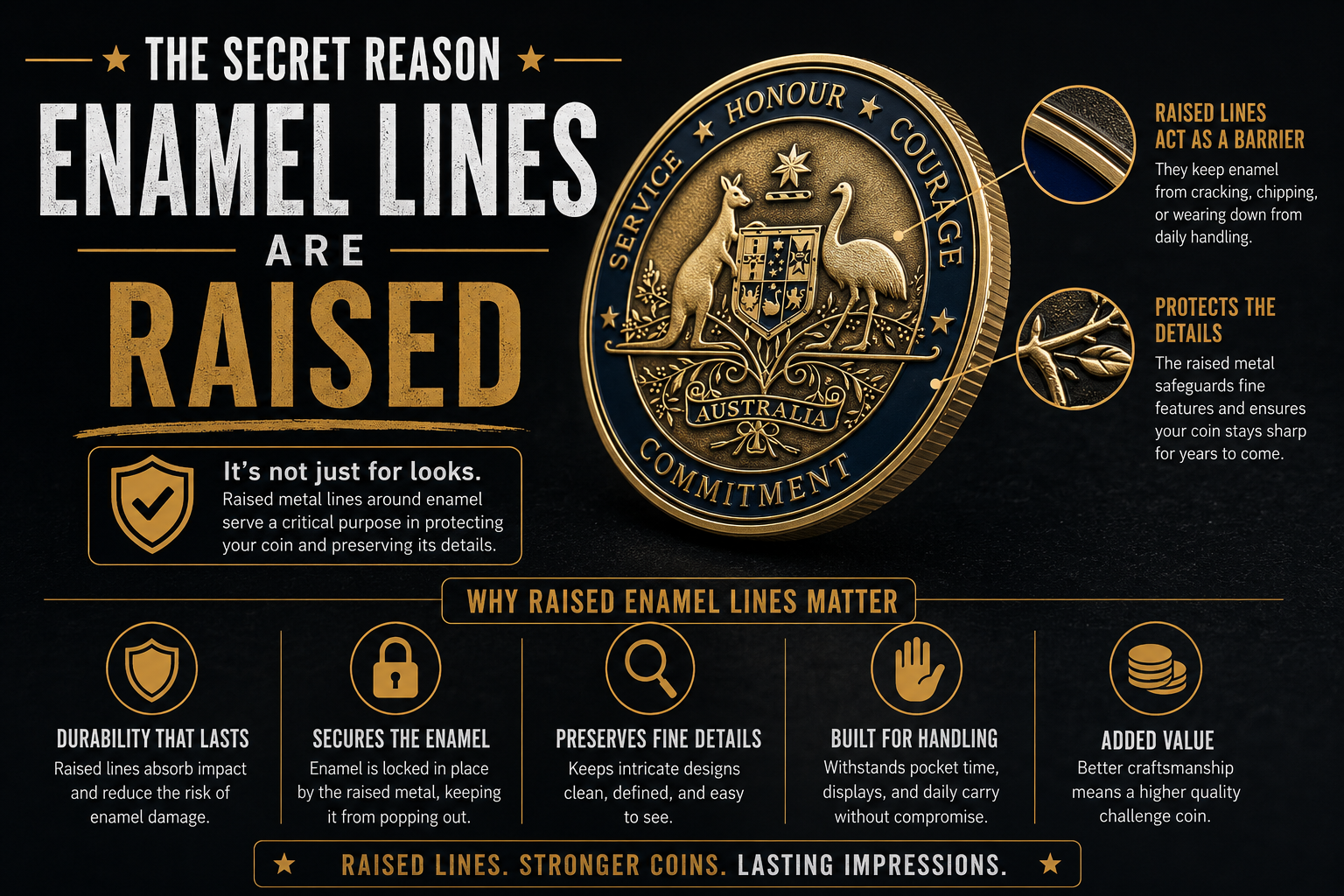
1. Colour containment during filling. As described above, the raised ridges physically prevent liquid enamel from flowing across design boundaries. Each colour compartment is its own sealed chamber, allowing precise multi-colour artwork without masking or post-cure correction.
2. Edge protection against chipping. Enamel, even when fully cured, is brittle. Coins get knocked around — tossed on bars, slapped on tables in the traditional challenge ritual, dropped on parade grounds. The raised metal rim surrounding each enamel fill acts as a protective curb, absorbing and deflecting edge impacts that would otherwise chip or crack the colour fill.
3 .Tactile dimensionality and perceived quality. There’s a reason luxury goods — watches, military medals, high-end lapel pins — use raised metalwork with recessed enamel. The contrast between the slightly sunken colour and the elevated metal creates a shadow and highlight that reads as craftsmanship and weight. A coin with flat printed colour simply doesn’t feel the same in the hand, and feels less authoritative.
4. Plating adhesion integrity. Challenge coins are almost always finished with an electroplated layer — gold, silver, antique brass, black nickel, and so on. The raised metal lines are part of the base metal coin body and receive this plating uniformly. The plating process would be compromised if it had to traverse enamel surfaces (enamel doesn’t plate well). The raised borders ensure the metalwork and enamel remain distinct substrates, each finished appropriately for its material.
5. Long-term colour fidelity. Over years of handling, the slightly recessed enamel is shielded from the most abrasive contact by its surrounding ridges. The metal wears first — which is by design. A well-worn challenge coin shows burnished high points of metal and still-bright enamel in the recesses, which many collectors consider far more beautiful than a pristine specimen.
The Cloisonné Ancestry
None of this is new. The raised-metal-with-recessed-enamel technique is ancient. Cloisonné — from the French word for “compartment” — dates back at least to the Byzantine Empire and was refined to an art form in medieval Europe and imperial China.
Artisans would solder thin wires of gold or silver onto a metal base, creating cells (cloisons), then fill each cell with powdered colored glass, and fire the whole piece in a kiln. The result: vivid, permanent colour bounded by bright metalwork.
Challenge coins inherit this exact logic. The die-struck or cast raised lines on a modern challenge coin are, in essence, an industrially-produced version of those hand-soldered cloisonné wires.
The material economics changed.
The physics didn’t.
Soft enamel coins — by far the most common type — have recessed color and raised metal lines you can feel with your fingernail. Hard enamel coins (also called cloisonné coins) are filled, baked, and then polished flat so the enamel sits flush with the metal.
Hard enamel costs more and takes longer to produce, but creates a glassy, jewel-like surface. Both types rely on raised walls during the filling process; hard enamel
simply adds a final polishing step that removes the tactile ridge sensation.
How the Die Creates the Raised Lines
The raised borders don’t require a separate manufacturing step — they’re born from the same die-striking process that gives the coin its design. A coin die is essentially a hardened steel negative of the final coin face. When a blank metal disc is pressed between the obverse and reverse dies under enormous hydraulic pressure, metal flows into the recesses of the die and is pushed up into relief where the die is carved away.
The coin designer — working today in digital tools, historically in wax or clay — must intentionally design every colour boundary as a raised ridge. This requires thinking about the artwork not as a flat graphic, but as a topographic map.
Where you want a color boundary, you design a small wall. Where you want a background field, you design a recess. The colours are never part of the design file; they are decisions made after the metal form is set, applied into the architecture the die-striker has already built.
This is why challenge coin design is genuinely a craft discipline distinct from graphic design. A logo designer can place two colors adjacent with a hairline rule between them.
A coin designer must account for the physical fact that those colours will be liquid during production, that they must each have a containing vessel, and that the vessel itself — the raised metal line — will be a visible, permanent, prominent part of the final object.
Why It Matters to the Tradition
Challenge coins carry the weight of organisational identity — unit crests, agency seals, presidential insignia, firefighter emblems. The symbolism encoded in their imagery is serious business to the people who carry them. The raised enamel dam system means that symbolism is durable. The eagle doesn’t bleed into the stars. The department colours stay true a decade after the coin was struck.
There’s something quietly fitting about a tradition built on loyalty and precision being manufactured using a technique whose entire purpose is to hold things in their proper place — to keep each element bounded, vivid, and distinct, no matter how much the coin gets handled, tested, and passed from hand to hand.
The next time someone slaps a challenge coin on the bar and dares you to produce yours, take a moment before you toss it down. Feel those ridges.
They’re not just decoration. They’re the reason the coin still looks exactly like it did the day it was made.
Every raised line is a promise: this colour will still be here when the coin is fifty years old and has been around the world twice.